Schottenbauer Publishing

Showing posts with label Education. Show all posts

Wednesday, March 23, 2016

Music Trajectories

Trajectories are essential to the science of music performance, but music majors rarely study the physics of motion. Consider the following graph of a conductor beating in 4/4 time:


Discussion Questions

  1. Draw a picture of the conductor from the camera's view. Label the points at which each of the beats are located. 
  2. How is it possible on the graph to determine the change of direction of the baton? 
  3. What is the form of mathematics which describes changes in motion? 
  4. What is the maximum velocity of the baton? 
  5. Is the acceleration of the baton 0 at any point in the graph? If so, what are the coordinates? 
  6. Comparing the minimum and maximum points, does the baton move a greater absolute distance in the x or y direction? 
  7. What is the total length of trajectory of the baton in the x direction? In the y direction? 
  8. Calculate the difference between initial and final positions of the baton. 


Additional graphs of music performance can be located in Volume 3 of How Do You Play That Thingamabob? The Science of Music Performance from Schottenbauer Publishing. These graphs can be integrated into music education curricula from late elementary school through high school and college/university.


Additional Information

Schottenbauer Publishing

Free Education Resources

Friday, March 11, 2016

Science of Music Memorabilia

Celebrate science of music with memorabilia from Zazzle! Colorful graphs from Schottenbauer Publishing are featured on these mugs, magnets, keychains, & postcards. Graphs include conducting, voice, piano, violin, recorder, flute, clarinet, saxophone, trumpet, trombone, drums, cymbal, and Tibetan bowl. A direct link is included below:
A variety of other STEM education collections are also available from Schottenbauer Publishing on Zazzle, which features regular sales on most items.  


Additional Information


Friday, December 18, 2015

Acoustics Comparison: Carpet and Vinyl Flooring


What are the acoustic properties of flooring? The following sound samples from SoundCloud can be used to compare these two common flooring options!


Sound Samples


Questions
  1. Describe the sound in each sample.
  2. On a scale of 1 (none) to 10 (highest), rate the amount of each of the following in each sample:
    1. Resonance
    2. Echo
    3. Damping
    4. Decay
  3. Which of the following tone qualities applies most to sample 1? Sample 2?
    1. Mellow
    2. Harsh
    3. Bold
    4. Jazzy
    5. Buzzy
    6. Loud
    7. Metallic
    8. Edgy
    9. Smooth
    10. Tinny
  4. Which flooring is better for recording music? Why?
  5. Bonus Questions:
    1. What is the instrument?
    2. What is the name of the tune?

Learn more about the science of music with books and multimedia from Schottenbauer Publishing!


Additional Information

Monday, October 5, 2015

Harmonic Overtone Series Lesson Plan

The harmonic overtone series is essentially related to music performance, but may easily be overlooked in music lessons or classes. Lesson plan material is available in several books on the science of music offered by Schottenbauer Publishing. Relevant information includes calculations, diagrams, graphs of real data from various musical instruments, and graphs calculated from mathematical formulas.

Consider the following pages, excerpted from Where Does Sound Come From? Volume 1 (Copyright 2014, All Rights Reserved). 


Discussion Questions

  1. Identify the relationship between harmonics and overtones, using words.
  2. Express the relationship between harmonics and overtones, using a mathematical formula.
  3. Draw a three-octave keyboard on paper, using a light gray color for the black keys. Make 12 copies on a printer or copier. Label each page on the top with a different chromatic note (A, A#/Bb, C, etc.). Starting on each chromatic note, color the entire harmonic overtone series. List the names of each note on the keys.
  4. Using a keyboard, any musical instrument, or voice, practice playing each harmonic overtone series. Begin on the lowest note possible, to ensure enough range to complete the task.

The resources below provide additional sources of information for learning about harmonics and the overtone series:


Auditory Demonstration of Harmonics


Math of Harmonics & Tuning Systems


Additional Information

Wednesday, July 29, 2015

What is Sound? The Problem of Averaging a Messy Graph

Graphs provide a unique perspective into the nature of music and sound. Graph-reading skills can be integrated into music classes, supplementing traditional science and math curricula. 

For example, consider the following two graphs, excerpted from Where Does Sound Come From? Volume 1 from Schottenbauer Publishing. These graphs shed light on a perplexing problem pertaining to averages.


Discussion Questions
  1. Does the graph suggest (a) the presence of wind, (b) random differences in gas pressure in the room, or (c) error of the measurement device?
  2. Is it accurate to state that the gas pressure is: (a) 99.8, (b) 99.825, (c) 99.85, (d) constantly changing?


Discussion Questions
  1. What are the initial maximum and minimum sound pressures in the graph?
  2. By the end of the graph, what are the maximum and minimum sound pressures?
  3. Using a solid line, trace the maximum values of the sound pressures.
  4. Using a solid line, trace the minimum values of the sound pressures.
  5. Is it appropriate to average the minimum and maximum values on this graph, in order to show the true sound pressure reading? Why or why not?

Additional graphs of sound pressure, gas pressure, wind speed, and physical vibrations (force) are available in the lab manual Where Does Sound Come From? Volume 1 from Schottenbauer Publishing. Students can use these measurements to understand the nature of sound, by comparing and contrasting graphs from 27 musical instruments, including strings, woodwinds, brass, and percussion, plus voice.


Additional Information

Thursday, May 7, 2015

Easy Science of Music Experiment

With the assistance of a computer, microphone, and free program download, anyone with a musical instrument can explore the science of music! Even with a plastic soprano recorder costing $5 or less at a local music store, students can gather meaningful data for a school project or summer academic enrichment activity. Simply follow the steps below, to begin to collect and analyze data.

Science of Music Activity

  1. Download Audacity, a free internet program for recording and mixing sound.
  2. Open the program, and use a microphone and a musical instrument or voice to record a few notes. You may also record music with other software, and then open the file in Audacity for editing. It may be necessary to convert the file first to a format read by Audacity. Converting files is easy with a program such as DVDVideoSoft's Free Audio Converter.
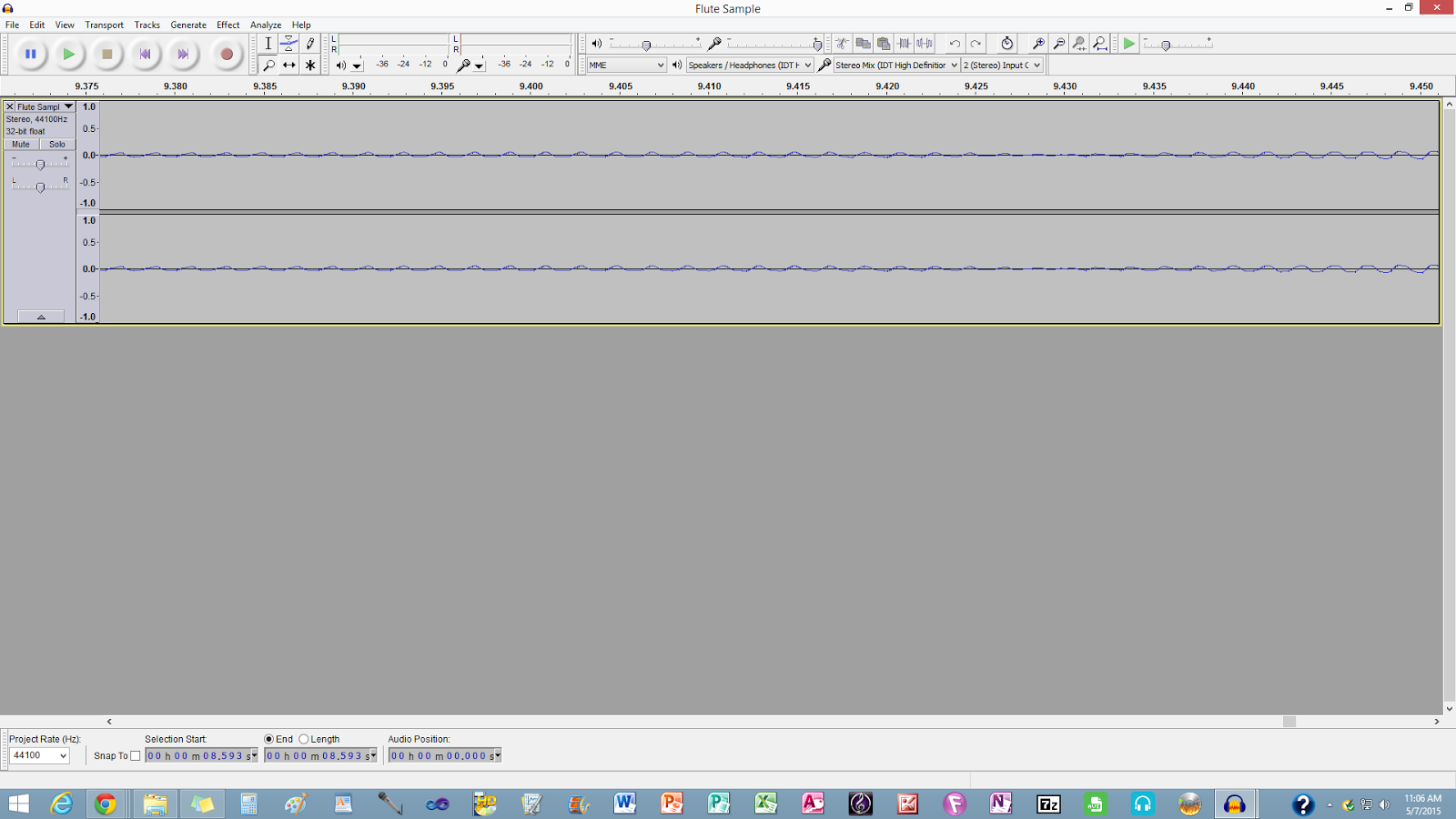
  3. Explore the sound wave, using the zoom function (magnifying glass icon). What does the wave look like?
  4. Use these steps to compare several sound waves. Try comparing different notes or different instruments. Or, try comparing an instrument to voice.

Example: Flute Solo

The following flute solo was recorded and opened in Audacity.


Using the zoom function several times provides more detail, but the sine waves are still obscured.


Further use of the zoom function reveals the sine wave.


Individuals interested in comparing the sound waves of musical instruments may benefit from the following publications from Schottenbauer Publishing, which, as a group, contain samples from typical Western strings, woodwinds, brass, percussion, and keyboard instruments, plus voice and conducting:


Other science of music publications from the same publisher include:

These educational tools can be integrated into music education curricula from late elementary school through high school and college/university. Additional information is available on the Schottenbauer Publishing website, and from the links below. A free pamphlet from the publisher is also available on the website.


Additional Information

Monday, April 13, 2015

How to Use Graphs in Music Education

Graphs can be integrated into music education from approximately fourth grade through high school, as well as college and university classes. 


The following list describes possible learning activities centered on graphs:

Possible Lesson Plans

  • Graph Reading 
    • Identifying Minimum & Maximum 
    • Determining Graph Shape 
    • Redrawing the Graph on a Different Scale 
  • Mathematical Modeling 
    • Writing the Graph's Equation 
    • Transforming the Graph's Equation 
  • Theoretical Analysis 
    • Describing the Scientific & Mathematical Concepts Related to Graph(s) 
    • Describing the Scientific & Mathematical Theories Related to Graph(s) 
    • Identifying the Theoretically Ideal Graph & Comparing to Individual Graph(s) 
    • Understanding Measurement Error & Other Types of Error 
    • Comparing & Contrasting Specific Graphs 
  • Science Writing 
    • Describing a Graph in Words 
    • Writing a Comparison & Contrast of Graphs 
    • Describing Scientific Concepts & Theories Relevant to Graphs 
    • Developing Theories Based on Graphs 
    • Re-writing Graph Titles in Scientific Format 
    • Practicing Different Styles of Writing about Graphs (e.g., Journalistic, Scientific, Practical/Colloquial) 
  • Exploratory Research 
    • Data-Mining 
    • Developing Theories Based on Graphs 
    • Exploring Open-Ended Questions (e.g., Look at this book of graphs and write about a topic of interest.) 
  • Estimation Skills 
    • Understanding Range & Order of Magnitude 
    • Developing Theoretical Comparisons from Commonly Available Data (e.g., Here is a graph of air flow while playing a note on a trombone mouthpiece. How much air would be required to play on a trumpet mouthpiece? On a tuba? Euphonium? Flugelhorn?) 

A full listing of books with graphs from Schottenbauer Publishing, indexed by book series and data type, are available in a Teacher Resource Guide from the publisher. Additional information about using graphs in class is available on the blog Graphs in Education.


Additional Information

Tuesday, September 30, 2014

Why Study the Science of Music?

Science of music provides essential information for individuals who take the time to care about equations, numbers, and graphs. Equations and line graphs possess a curious ability to reveal essential details about technique, and therefore can provide a unique tool for teaching.

For example, the graph below, excerpted from Volume 4 of Where Does Sound Come From? (Copyright 2013, All Rights Reserved), shows three different notes performed on the trumpet. The first two notes have poor technique for the beginning, and the third note has a good beginning, middle, and end. What are the differences between the three notes on the graph?


Educators whose students struggle with auditory concepts may make a more bold statement with graphs such as the one found above. When auditory processing has not yet been trained, students with graph-reading skills, typically taught beginning in 5th grade, may use visual estimation or a ruler to measure the differences between types of tone.


Several options from Schottenbauer Publishing offer the ability to integrate ear training with visual analysis and graph-reading skills, for a unique and robust approach to music education. These include the following books, which, as a group, contain samples from typical Western strings, woodwinds, brass, percussion, and keyboard instruments, plus voice and conducting:


These educational tools can be integrated into music education curricula from late elementary school through high school and college/university. Additional information is available on the Schottenbauer Publishing website, and from the links below. A free pamphlet from the publisher is also available on the website.


Additional Information

Friday, September 26, 2014

Bow Science and Exercises: Clear, Concise Instruction for Students of All Ages


Students who seek rapid development of bowing skills can find clear instruction in a newly published series of books by M. Schottenbauer, Ph.D., Bow Science & Exercises for Violin & Viola. This growing series of books contains progressive levels of information and advice, including instruction in basic math and physics, plus convenient exercises which may rapidly advance control over the bow arm, hand, and fingers. 

Sample pages (Copyright 2014, All Rights Reserved) are located on the slides below, which highlight features from the book:


A brief YouTube video about the book series is also available.


Additional Information


Unbeatable Specials

With Kindle Unlimited ($9.99/month) at Amazon.com, you can read all e-books from Schottenbauer Publishing for no extra charge! Amazon offers Free 30-Day Trials of Kindle Unlimited. With this deal, trial members can read all Schottenbauer Publishing e-books free! This includes the Bow Science & Exercise Series, plus all the geometry workbooks, "The World in a Graph," "Alphabets of the World," all the e-book puzzles, and the educational novels by M. Schottenbauer, Ph.D.

Monday, August 4, 2014

The Science of Music Performance


Science of music is easy and fun to teach and learn with several new book series from Schottenbauer Publishing! M. Schottenbauer, Ph.D.'s books of graphs provide a visual analysis of both sound and musical performance technique. Music instructors can use these graphs to add a dimension of understanding to traditional musical concepts. For instance, teachers can now use these books of graphs to show students the differences between smooth wave functions and the "wobbly" nature of uneven tone, the "edginess" of a bad note entrance, or the "droopiness" of a note going flat at the end. These books may be particularly useful in band, orchestra, or choral classes, where it is inconvenient or prohibitively expensive to use scientific equipment to illustrate concepts on individual student performance.

The book series by M. Schottenbauer, Ph.D., currently contain data from common band and orchestral instruments, plus recorders, keyboard, voice, and conducting. The samples include both good and bad sound and technique, thus providing a comparison and contrast for educational purposes. 


  • Where Does Sound Come From?
    • Volume 1: 27 Instruments plus Voice
      •  Gas Pressure Sensor
      • Wind Speed Sensor
      • Dual-Range Force Meter
      • Sound Pressure Meter
    • Volume 2, Revised Edition: Over 20 Instruments
      • Continuous Sound Level Meter
      • Diagrams of Tuning Systems
    • Volume 3: Classical & Folk Guitars
      • Gas Pressure Sensor
      • Wind Speed Sensor
      • Dual-Range Force Meter
      • Sound Pressure Meter
    • Volume 4: Violin, Recorder, Flute, Clarinet, Trumpet, with a Focus on Phrasing, Articulation, and Tone
      • Sound Pressure Meter


  • How Do You Play That Thingamabob? The Science of MusicPerformance
    • Volume 1: Over 20 Instruments
      • Dual-Range Force Meter
      • Force Plate
      • Motion Detector
      • Gas Pressure Sensor
      • Wind Speed Sensor
      • Air Volume Bag
    • Volume 2: Over 20 Instruments, plus Voice and Conducting
      • Goniometer
      • Spirometer
    • Volume 3: Over 20 Instruments, plus Conducting
      • Video Analysis


In addition to the above books, M. Schottenbauer, Ph.D. has been writing short textbook-style volumes about the science of each family of musical instruments. These short textbooks are written in big print with diagrams so as to be particularly suitable for children, as well as beginning students of any age. 


Vendors

Amazon & Worldwide Affiliates

Barnes & Noble

Books-a-Million

CreateSpace

CreateSpace Wholesale


Unbeatable Specials

With Kindle Unlimited ($9.99/month) at Amazon.com, you can read all e-books from Schottenbauer Publishing for no extra charge! Amazon offers Free 30-Day Trials of Kindle Unlimited. With this deal, trial members can read all Schottenbauer Publishing e-books free! This includes the Bow Science & Exercise Series, plus all the geometry workbooks, "The World in a Graph," "Alphabets of the World," all the e-book puzzles, and the educational novels by M. Schottenbauer, Ph.D.