Schottenbauer Publishing

Showing posts with label elementary. Show all posts

Friday, December 18, 2015

Acoustics Comparison: Carpet and Vinyl Flooring


What are the acoustic properties of flooring? The following sound samples from SoundCloud can be used to compare these two common flooring options!


Sound Samples


Questions
  1. Describe the sound in each sample.
  2. On a scale of 1 (none) to 10 (highest), rate the amount of each of the following in each sample:
    1. Resonance
    2. Echo
    3. Damping
    4. Decay
  3. Which of the following tone qualities applies most to sample 1? Sample 2?
    1. Mellow
    2. Harsh
    3. Bold
    4. Jazzy
    5. Buzzy
    6. Loud
    7. Metallic
    8. Edgy
    9. Smooth
    10. Tinny
  4. Which flooring is better for recording music? Why?
  5. Bonus Questions:
    1. What is the instrument?
    2. What is the name of the tune?

Learn more about the science of music with books and multimedia from Schottenbauer Publishing!


Additional Information

Monday, October 5, 2015

Harmonic Overtone Series Lesson Plan

The harmonic overtone series is essentially related to music performance, but may easily be overlooked in music lessons or classes. Lesson plan material is available in several books on the science of music offered by Schottenbauer Publishing. Relevant information includes calculations, diagrams, graphs of real data from various musical instruments, and graphs calculated from mathematical formulas.

Consider the following pages, excerpted from Where Does Sound Come From? Volume 1 (Copyright 2014, All Rights Reserved). 


Discussion Questions

  1. Identify the relationship between harmonics and overtones, using words.
  2. Express the relationship between harmonics and overtones, using a mathematical formula.
  3. Draw a three-octave keyboard on paper, using a light gray color for the black keys. Make 12 copies on a printer or copier. Label each page on the top with a different chromatic note (A, A#/Bb, C, etc.). Starting on each chromatic note, color the entire harmonic overtone series. List the names of each note on the keys.
  4. Using a keyboard, any musical instrument, or voice, practice playing each harmonic overtone series. Begin on the lowest note possible, to ensure enough range to complete the task.

The resources below provide additional sources of information for learning about harmonics and the overtone series:


Auditory Demonstration of Harmonics


Math of Harmonics & Tuning Systems


Additional Information

Thursday, May 7, 2015

Easy Science of Music Experiment

With the assistance of a computer, microphone, and free program download, anyone with a musical instrument can explore the science of music! Even with a plastic soprano recorder costing $5 or less at a local music store, students can gather meaningful data for a school project or summer academic enrichment activity. Simply follow the steps below, to begin to collect and analyze data.

Science of Music Activity

  1. Download Audacity, a free internet program for recording and mixing sound.
  2. Open the program, and use a microphone and a musical instrument or voice to record a few notes. You may also record music with other software, and then open the file in Audacity for editing. It may be necessary to convert the file first to a format read by Audacity. Converting files is easy with a program such as DVDVideoSoft's Free Audio Converter.
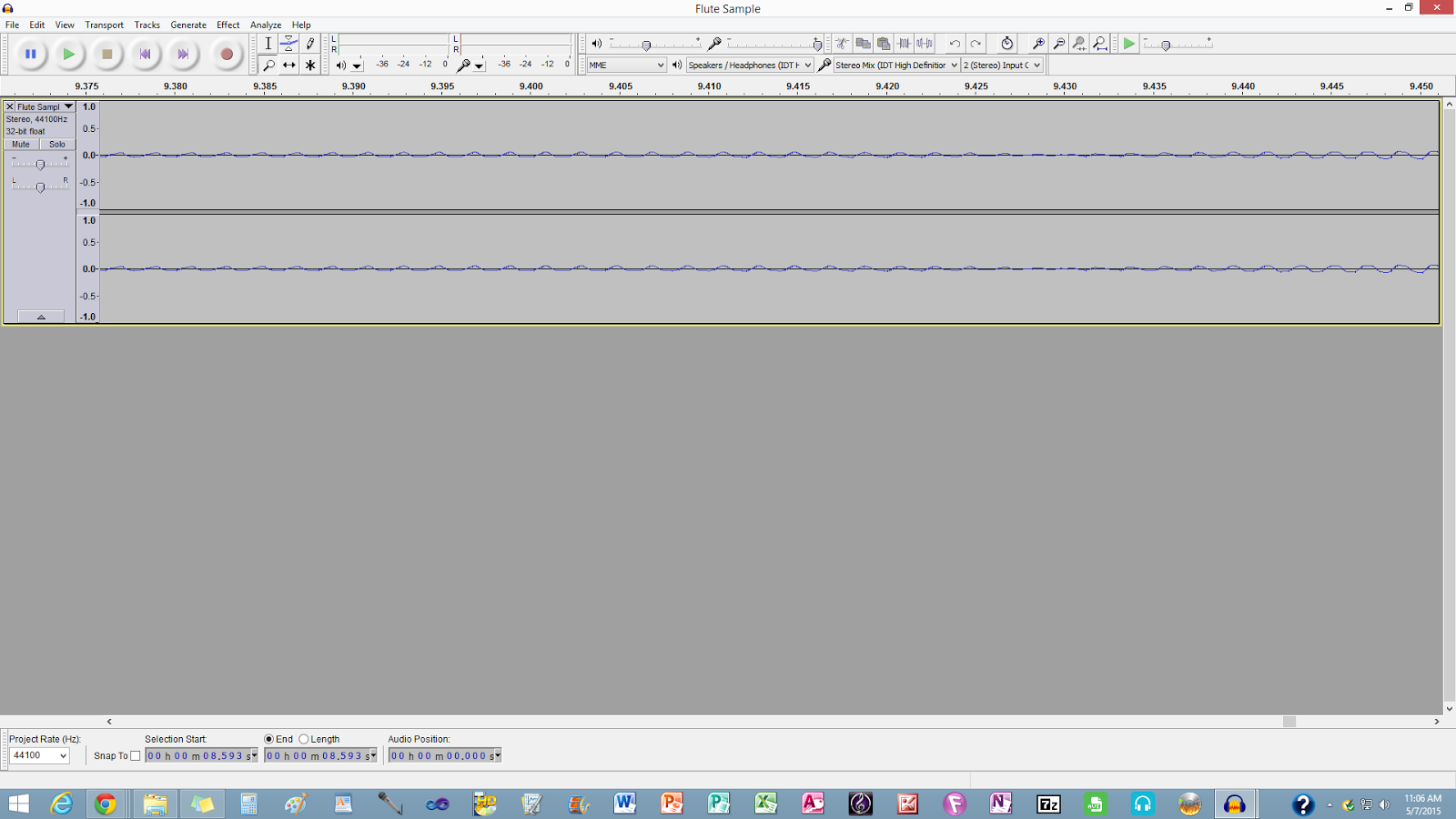
  3. Explore the sound wave, using the zoom function (magnifying glass icon). What does the wave look like?
  4. Use these steps to compare several sound waves. Try comparing different notes or different instruments. Or, try comparing an instrument to voice.

Example: Flute Solo

The following flute solo was recorded and opened in Audacity.


Using the zoom function several times provides more detail, but the sine waves are still obscured.


Further use of the zoom function reveals the sine wave.


Individuals interested in comparing the sound waves of musical instruments may benefit from the following publications from Schottenbauer Publishing, which, as a group, contain samples from typical Western strings, woodwinds, brass, percussion, and keyboard instruments, plus voice and conducting:


Other science of music publications from the same publisher include:

These educational tools can be integrated into music education curricula from late elementary school through high school and college/university. Additional information is available on the Schottenbauer Publishing website, and from the links below. A free pamphlet from the publisher is also available on the website.


Additional Information

Monday, April 13, 2015

How to Use Graphs in Music Education

Graphs can be integrated into music education from approximately fourth grade through high school, as well as college and university classes. 


The following list describes possible learning activities centered on graphs:

Possible Lesson Plans

  • Graph Reading 
    • Identifying Minimum & Maximum 
    • Determining Graph Shape 
    • Redrawing the Graph on a Different Scale 
  • Mathematical Modeling 
    • Writing the Graph's Equation 
    • Transforming the Graph's Equation 
  • Theoretical Analysis 
    • Describing the Scientific & Mathematical Concepts Related to Graph(s) 
    • Describing the Scientific & Mathematical Theories Related to Graph(s) 
    • Identifying the Theoretically Ideal Graph & Comparing to Individual Graph(s) 
    • Understanding Measurement Error & Other Types of Error 
    • Comparing & Contrasting Specific Graphs 
  • Science Writing 
    • Describing a Graph in Words 
    • Writing a Comparison & Contrast of Graphs 
    • Describing Scientific Concepts & Theories Relevant to Graphs 
    • Developing Theories Based on Graphs 
    • Re-writing Graph Titles in Scientific Format 
    • Practicing Different Styles of Writing about Graphs (e.g., Journalistic, Scientific, Practical/Colloquial) 
  • Exploratory Research 
    • Data-Mining 
    • Developing Theories Based on Graphs 
    • Exploring Open-Ended Questions (e.g., Look at this book of graphs and write about a topic of interest.) 
  • Estimation Skills 
    • Understanding Range & Order of Magnitude 
    • Developing Theoretical Comparisons from Commonly Available Data (e.g., Here is a graph of air flow while playing a note on a trombone mouthpiece. How much air would be required to play on a trumpet mouthpiece? On a tuba? Euphonium? Flugelhorn?) 

A full listing of books with graphs from Schottenbauer Publishing, indexed by book series and data type, are available in a Teacher Resource Guide from the publisher. Additional information about using graphs in class is available on the blog Graphs in Education.


Additional Information