Schottenbauer Publishing

Showing posts with label physical science. Show all posts

Wednesday, July 29, 2015

Decibels & Hearing

Decibels are the measurement unit for the level of sound. Noise level is measured on a logarithmic scale, with the threshold of hearing at 0 decibels. On this scale, a typical conversation is approximately at 60 decibels, a vacuum cleaner at 70 decibels, and a jackhammer at 100 decibels. 

According to OSHA, high sound level exposure is linked to hearing loss, particularly if the exposure to loud noises is prolonged over time. OSHA's permissible exposure limit is approximately 90 decibels.

Are musical instruments safe to perform? Consider the graph below, excerpted from Where Does Sound Come From? Volume 2, Revised Ed., from Schottenbauer Publishing:


Discussion Questions
  1. Approximately what is the decibel level of the ambient sound in the room?
  2. Approximately what is the decibel level of the trumpet?

Decibel readings are the theme of Where Does Sound Come From? Volume 2, Revised Ed., from Schottenbauer PublishingStudents can use these measurements to understand the nature of sound, by comparing and contrasting graphs from 27 musical instruments, including strings, woodwinds, brass, and percussion, plus voice.


Additional Information

What is Sound? The Problem of Averaging a Messy Graph

Graphs provide a unique perspective into the nature of music and sound. Graph-reading skills can be integrated into music classes, supplementing traditional science and math curricula. 

For example, consider the following two graphs, excerpted from Where Does Sound Come From? Volume 1 from Schottenbauer Publishing. These graphs shed light on a perplexing problem pertaining to averages.


Discussion Questions
  1. Does the graph suggest (a) the presence of wind, (b) random differences in gas pressure in the room, or (c) error of the measurement device?
  2. Is it accurate to state that the gas pressure is: (a) 99.8, (b) 99.825, (c) 99.85, (d) constantly changing?


Discussion Questions
  1. What are the initial maximum and minimum sound pressures in the graph?
  2. By the end of the graph, what are the maximum and minimum sound pressures?
  3. Using a solid line, trace the maximum values of the sound pressures.
  4. Using a solid line, trace the minimum values of the sound pressures.
  5. Is it appropriate to average the minimum and maximum values on this graph, in order to show the true sound pressure reading? Why or why not?

Additional graphs of sound pressure, gas pressure, wind speed, and physical vibrations (force) are available in the lab manual Where Does Sound Come From? Volume 1 from Schottenbauer Publishing. Students can use these measurements to understand the nature of sound, by comparing and contrasting graphs from 27 musical instruments, including strings, woodwinds, brass, and percussion, plus voice.


Additional Information

Saturday, May 9, 2015

The Science of Tone Quality

Tone quality is essential to all musical performance, but is not usually taught systematically in traditional music education. Rather than building an awareness of tone across instruments, individuals taking lesson in strings, woodwinds, brass may be offered individual suggestions for improving tone on their own instrument. Usually, their instrument is a student or intermediate model. If fortunate to take private lessons, students may also be provided exemplary tone quality examples from a specialist teacher performing on a professional instrument. In ensemble, students may be urged to "match tone quality" across their section, even when performing on different makes and models of instruments, which offer various tone quality. Options for learning about tone quality are even more limited on the piano, which is a common tool for music education.

How can educators and students learn about tone quality across the spectrum of band and orchestral instruments? A set of educational materials from Schottenbauer Publishing offer opportunities for learning multiple aspects of tone quality, including:

  • Identifying tone quality in band and orchestral instruments
  • Understanding the math and science of tone quality
  • Linking instrumental skills to auditory and math/science skills


To meet the first goal, the student can obtain recordings of multiple instruments, including common examples of good and poor tone quality. By listening carefully to comparison and contrast examples, and reading descriptions of each sample in words, students can develop and hone skills for identifying good tone. The multimedia set Ear Training: Tone Quality (Level 1) from MusicaNeo contains over 250 computer audio files with performance samples from common musical instruments, including strings, woodwinds, brass, and percussion. The series is accompanied by a brief lead sheet with exercises for improving tone quality, as well as an audio file with a computer realization of the exercises.  

To meet the second goal, the student can obtain graphs of tone quality samples from multiple instruments, including common examples of good and poor tone quality. By comparing these tone samples visually, and by reading descriptions of each sample in words, students can develop a mathematical/graphical understanding of good tone. The book series Where Does Sound Come From? and the anthology The Science of Music provide graphs with performance samples from common musical instruments, including strings, woodwinds, brass, and percussion. The graph below provides one example of the contents of these book series.


To meet the third goal, students can record their own musical performance on a microphone at the computer, and analyze the sound wave using a free program such as Audacity. Students can follow procedures from the free blog article Easy Science of Music Experiment to analyze their tone quality.

These educational tools can be integrated into music education curricula from late elementary school through high school and college/university, in classrooms, after-school enrichment programs, individual lessons, independent study, and/or homeschool. Additional information is available on the Schottenbauer Publishing website, and from the links below. A free pamphlet from the publisher is also available on the website.


Additional Information

Thursday, May 7, 2015

Easy Science of Music Experiment

With the assistance of a computer, microphone, and free program download, anyone with a musical instrument can explore the science of music! Even with a plastic soprano recorder costing $5 or less at a local music store, students can gather meaningful data for a school project or summer academic enrichment activity. Simply follow the steps below, to begin to collect and analyze data.

Science of Music Activity

  1. Download Audacity, a free internet program for recording and mixing sound.
  2. Open the program, and use a microphone and a musical instrument or voice to record a few notes. You may also record music with other software, and then open the file in Audacity for editing. It may be necessary to convert the file first to a format read by Audacity. Converting files is easy with a program such as DVDVideoSoft's Free Audio Converter.
  3. Explore the sound wave, using the zoom function (magnifying glass icon). What does the wave look like?
  4. Use these steps to compare several sound waves. Try comparing different notes or different instruments. Or, try comparing an instrument to voice.

Example: Flute Solo

The following flute solo was recorded and opened in Audacity.


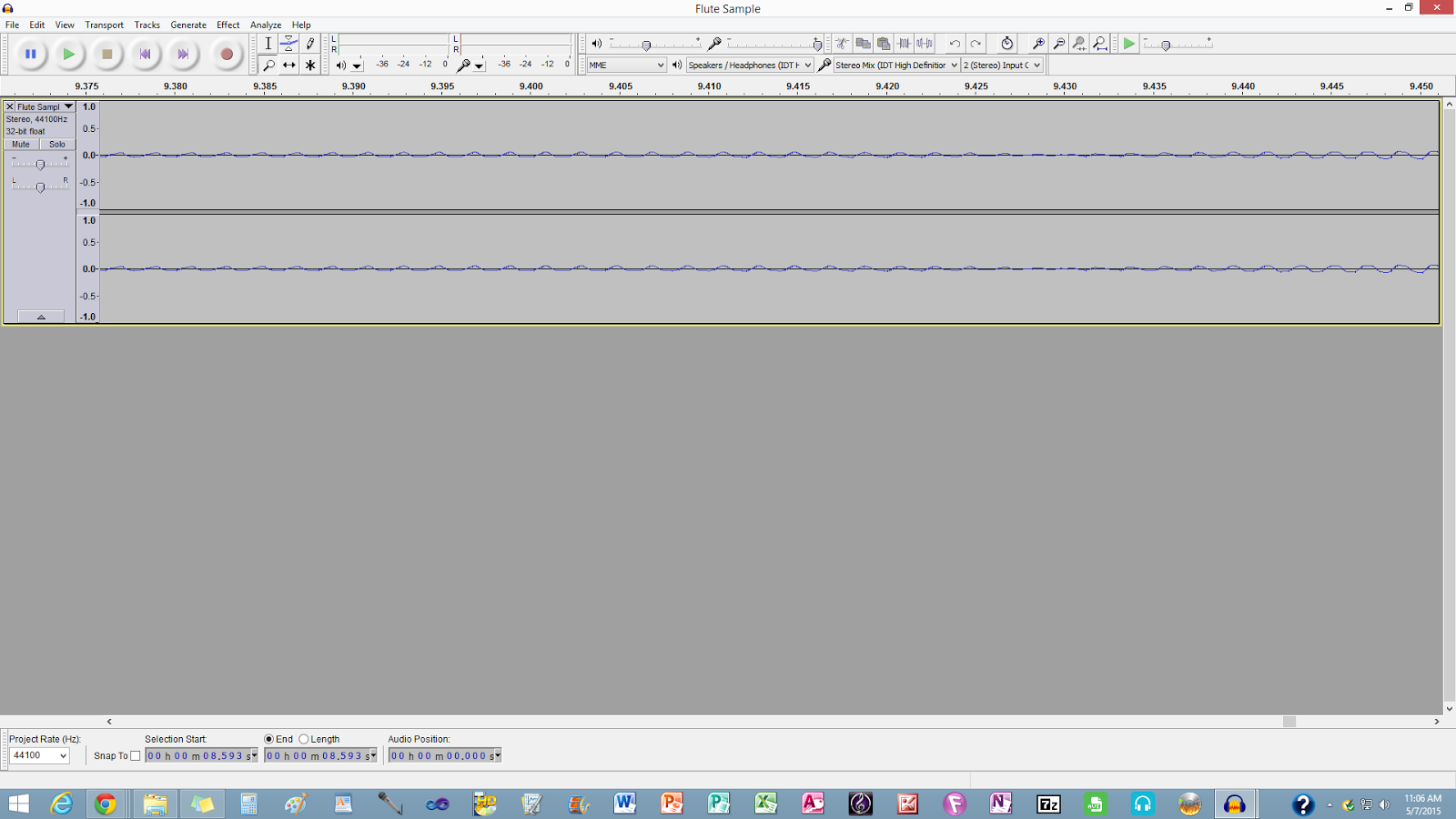
Using the zoom function several times provides more detail, but the sine waves are still obscured.


Further use of the zoom function reveals the sine wave.


Individuals interested in comparing the sound waves of musical instruments may benefit from the following publications from Schottenbauer Publishing, which, as a group, contain samples from typical Western strings, woodwinds, brass, percussion, and keyboard instruments, plus voice and conducting:


Other science of music publications from the same publisher include:

These educational tools can be integrated into music education curricula from late elementary school through high school and college/university. Additional information is available on the Schottenbauer Publishing website, and from the links below. A free pamphlet from the publisher is also available on the website.


Additional Information